


2026 K2 Cortex 140 Zonal BOA Ski Boots Review
By: Asa Redfield, Digital Content Editor | Published: May 19th, 2025

The Lowdown
All the BOA hype aside, the Cortex 140 Zonal BOA Ski Boots are hands down the most powerful, precise and progressive freeride boot from K2 yet. Don't believe me? Go watch a few of Sam Kuch's runs (wearing these very boots) in the inaugural NST Ski event and you'll be hard pressed to say they aren't capable of skiing at the absolute highest level... Inspired by those who're seeking ultimate downhill performance, the Cortex Series ditches any loyalty to being lightweight in favor of dampness and power. And while, yes, K2's boots have previously erred on the softer side of their flex ratings, I'm comfortable acknowledging the Cortex 140 as a legitimate powerhouse that even Lange-purists and plug boot ski racers will appreciate.
Shop K2 Cortex 140 Zonal BOA Ski Boots


Technical Details
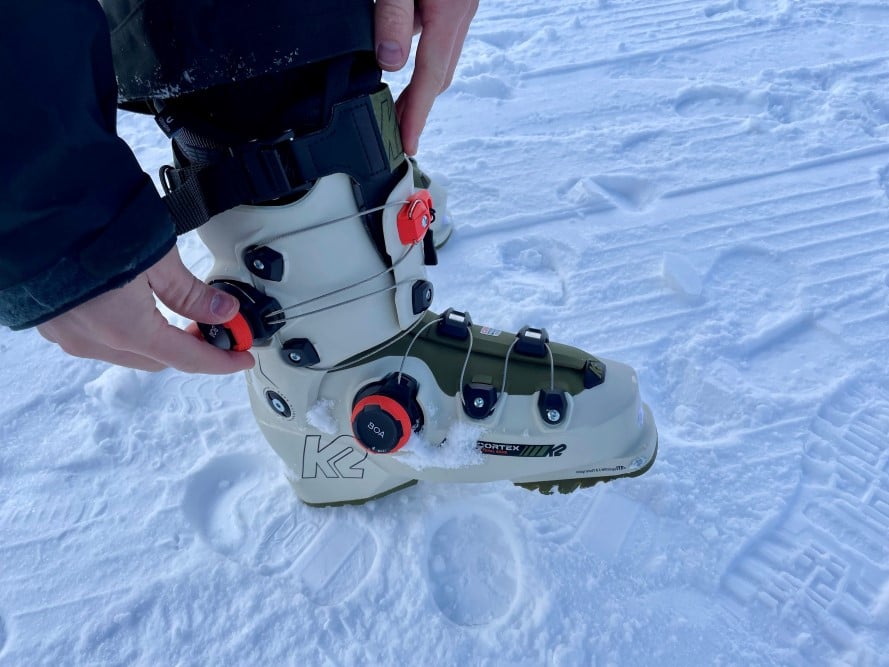
With the K2 Cortex 140 boots, the spotlight tends to land largely on the double BOA dials but the guts beneath the new closure system is—in my opinion—the bigger story here. At their core, the entire Cortex series represent a return to uncompromising downhill performance. In other words, these are a completely different class compared to the lighter weight 50/50 in-bounds/out-of-bounds boots like the Mindbenders, Hawx Ultra XTD, XT3 Free, or Cochise series of boots that have dominated freeride market share for the last 5+ years... Practically speaking, these boots are substantially heavier, damper, and consequently more powerful than any of K2's previous ski boot offerings—sans maaaybe the old K2 Spyne 130.
Again, BOA aside, K2 designed the entire Cortex line to provide the performance of a race boot but without the most common race boot qualms—namely hard soles, cold/uncomfortable boot boards, and ultra stiff single-material insteps.
Cortex 140 vs Cortex 130
On the surface, it appears that the only difference between the Cortex 140 and the Cortex 130 is the inclusion of tech toe fittings and the "Power Plate"... Which begs the question, can you acheive the same performance by just affixing a Power Plate to the cuff of the 130?However, after getting lots of questions about this and digging into it a bit, I uncovered that the 140's lower shell is also a stiffer construction. That said, the upper cuff is shared between the 140, 130, and women's Cortex 125; so no, even if you put a Power Plate on the Cortex 130, it still won't have the same feel as these.
| Flex Rating | 140 (Very Stiff) |
| Last Width | 96 - 98mm |
| Shell / Cuff Material | TPU / TPU |
| Liner | EliteFit Pro |
| Forward Lean | 15° |
| Ramp Angle | 2.5° |
| Outsole | GripWalk (ISO 23223) - Replaceable / Interchangeable |
| Walk Mode | No |
| Tech Fittings | Yes (Toe Only) |
| Boot Sole Length (BSL) | 315mm @ 27.5 |
| Weight | 2283g (sz 26.5) |
| Made In | Italy |


Ride Impressions
After spending this entire season with a pair of the K2 Cortex 140 Zonal BOA Ski Boots (size 27.5), my overall sentiment is that these are incredibly powerful boots that I believe are representative of a shifting tide back to uncompromising downhill performance. The dual BOA (aka Zonal BOA, aka double BOA) closure is eyecatching and arguably one of the more controversial topics in the industry, but whether or not it'll work for your anatomy will depend. While I really like the performance of these boots, I'd be hard pressed to say I wouldn't opt for the buckle version if K2 offered one. Let's get into it...
Performance
Downhill performance is these boots first, middle and last name. I'd say that K2's goal of creating boots that provide ultimate downhill performance was definitely achieved in the Cortex 140. With a thick TPU construction, burly flex, bolted spine, adjustable Power Plate, and excellent out-of-the-box power strap. These boots are not only super stiff, but they're also quite damp — meaning they do an excellent job of absorbing impacts and vibrations. On snow, their power and dampness translate to confidence through varied conditions, big landings, and comfortability skiing at high speeds.
Whether I was chasing buddies through tracked out mashed potatoes at Mt. Baker, dropping little cliffs at Whitefish, or railing down steep icy groomers at Schweitzer, the stiffness, dampness and overall heft of these boots translates to a confidence-inspiring feeling on snow. Also, don't be fooled by the inclusion of tech inserts at the toes, these boots are quite heavy (2283g per pair) but unless you're mistakenly thinking you'll frequently be embarking on big uphill missions with these, that weight is actually more of an asset than a burden. At least in my downhill-oriented opinion.
BOA
I'd say I have a love-hate relationship with BOA...
On one hand it certainly provides an excellent (dare I say, "superior") squeeze around the lower and upper portions of the boot which yields great performance —read: ultra secure, zero play, incredible heel hold. But on the other hand, you're not able to selectively isolate and choose different tensions for each part of the boot so I found myself messing with them constantly to regain circulation... And in practice, they're a lot more cumbersome than buckles to re-engage.
From a performance standpoint, the uniform wrapping and micro-adjustability across the two BOA zones definitely encouraged me to crank down my boots tighter than I would otherwise do with independent buckles. With that, I got incredibly responsive control (dare I say, "superior control") out of these boots. The downside, however, was that due to the uniformity of BOA closures, I really struggled with finding a happy medium in either zone. Which leads me to my next point...
From a comfort standpoint, due to the more uniform closure (which is due to the fact that they're ultimately leveraging a singular tensioner for the entire "zone", as opposed to traditional 4-buckle boots that split tension across independent buckles) I was never able to find that sweet spot of comfort and performance. Consequently, I found myself releasing the BOA dials on every chair ride to regain circulation and comfort. Now this isn't an entirely new concept to me, as I've become pretty accustomed to doing the same with traditional buckle boots—particularly through the beginning of a day. But my real frustrations came from how much more time consuming it was to re-tighten each BOA dial compared to the relative ease of quickly slapping down buckles on their already established ladders. To be fair, we're talking about maybe 3-5 seconds of time spent per dial, but the cumulative inconvenience vs the mere milliseconds it requires to quickly slap down a buckle latch felt akin to waiting for video to buffer; i.e. it became an annoyance, especially when you're crew has already taken off on the next lap.
Alas, if you are someone who's calf or foot anatomy requires disparity across buckle tensions, you might also struggle with BOA. Additionally, if you're someone who likes to crank your boots down tight on descents but routinely loosen everything up on the chair back up, you'll likely find the BOA closures more cumbersome than helpful. BUT if you're someone who's anatomy allows for more equivalent tensions across the upper and lower shell, the uniform wrapping achieved through the new BOA system is likely to be incredible. To me, this explains the polarizing debates we've all encountered online and ultimately echos what every devout skier already knows—there's no one-size-fits-all solution when it comes to ski boots.
Fit
Out of the box, the overall fit of these boots is very much in line with K2's previous "low volume" boots. K2 contends that the BOA closure on the lower shell allows the last to run from 96-98 and I'd say this maps in the real world too. Whereas traditional ladder buckles tend to collapse the lower shell over the top of your foot, the BOA cable and pulleys definitely produce more of a uniform wrapping effect. That said, with the stock liners, these boots have a relatively roomy toe box but also a tight heel pocket. The Cortex 140 also features a 100% heat moldable shell and liner as well as a grindable boot board so if your feet have any abnormalities (i.e. high instep, bunions, bone spurs, etc), you can rest assured that these boots can ultimately be conformed and customized to accommodate you. Worth note, the TPU shells are quite thick so you won't get quite as much stretch out of them as with lighter weight boots like their Mindbenders or Recons.
Liner
K2 has plopped their new "EliteFit Pro Liner" into these bad boys. While this is a relatively minimalist liner through the forefoot, instep, and tongue, they still offer a bit more foamy comfortsthan you'd typically find on a consumer level race boot—particularly through the heel and ankle areas. For me, this was a plus as I have relatively skinny ankles but large calves. It also meant that a quick heat mold went a long ways in making these more comfortable. All in, I'd say these are solid liners that you won't be necessarily itching to swap out to aftermarket liners right away.
A couple quick feature callouts for these liners include:
• Full lace-up design
• Adjustable tongue (via velcro tab)
• Ski Edge Sensitivity shims
• Pronounced ankle pockets
Longevity/Durability
Probably the most common quip I've heard or seen with regard to BOA ski boots is concern about their durability. Putting these boots through the wringer for a full season, I didn't once encounter a problem with their H+i1 BOA coilers or cables. That said, if you're an absolute menace to your gear or happen to knock one of the coilers extremely hard against a tree or rock, they are designed to pop off with enough force (or with a flathead screwdriver). If this were to happen, you can easily snap them back on. No tools required. Again, this never happened to me but I know it's a common concern. If you do somehow manage to break the coilers or cables, BOA offers both as replacement parts. You can check out their guide on repairing the H+i1 System.
• Removable/interchangeable soles also ensure a longer overall lifespan. Mine shipped with GripWalk (ISO 23223) attached and Alpine (ISO 5355) in the box.
• All screw-attached components (no rivets), including pulleys and H+i1BOA coilers. This makes it easy to remove various components for boot work and/or repairs.
Other Features
A few other notable callouts on these boots:
• Full width EVA boot board — significantly warmer, more shock absorbing, and more customizable than traditional plug race boots (they have a 2mm deep hexagonal pattern on top of each boot board that can be ground away to lower the foot/increase instep volume).
• Excellent Cam Booster power strap
• Removable/interchangeable outsoles (can be run as GripWalk or Alpine ISO 5355)
• Removable/adjustable Power Plate — this bolt-on front cuff spoiler can be raised, lowered, or removed to allow you to adjust the flex and sensitivity.
• Energy Bolt Spine top bolt can be removed to allow for a more progressive cuff response/slower rebound.
• Ski Edge Sensitivity Shims — can be added to the liner's cuff (medial side or lateral side) to change your skis edge angle.
Rating: ★★★★★ (5/5)


Pros
Extremely Stiff, Powerful, and Precise
Although ski boot flex ratings are anything but standardized, I'd say that the "140" rating is not misleading here. K2 has a reputation for being on the softer side of flex ratings, but I'd say these buck that trend. FWIW, they're substantially stiffer than my 140-flex K2 Recon Team boots...
Super Fine-Tunable
A micro-adjustable BOA fit system, dual cuff alignment for +/- 2 degrees of cuff adjustment, removable Energy Bolts in spine, removable Power Plate spoiler, liner Ski Edge Sensitivity shims, MultiLast 96-98mm forefoot width.
Zero BOA Durability Issues
Despite my pre-conceived doubts from online naysayer comments, I never experienced any BOA-related durability issues. In fact, they performed flawlessly in freeze-thaw conditions and they're also 100% repairable/replaceable.
Cons
BOA Dials Are Slow
Compared to the speed and relative ease of slapping down traditional ladder buckles, the BOA coilers are slow. If you're a "set it and forget it" type of person with your boots, this isn't really an issue, but if you're someone who frequently unbuckles your boots on the lifts, the ~3-5 seconds it takes to re-tighten each BOA ratchet is annoying in comparison to the split second it takes to slap down buckles. First world problem, but still.
Difficult On/Off
Despite the FastFit instep and releasing orange cable pulley tab, these are still quite difficult to get on. Although if you're accustomed to plug boots, the torture of getting into these might seem minor.
Uniform Wrap of BOA Is Not for Everyone
Depending on your anatomy, the "uniform wrapping" achieved through BOA closures will either work great or not so great... If you tend to have disparity across buckle tensions (e.g. skinny ankles, big calves), BOA may not be as accommodating.


Who Are They For?
The Cortex 140 Zonal BOA ski boots are for the hardest charging skiers, whether you're coming from racing DNA or just a freeride, big mountain purist. With an extremely stiff flex and double BOA closure, there's no doubt that these are some of the highest performance downhill boots in the game. That said, the more uniform squeeze you achieve with BOA ski boots is not for everyone's anatomy.
The Bottom Line
If you want a super stiff, super powerful boot that delivers ultimate downhill performance, there's no denying that the Cortex 140 Zonal BOA Ski Boots deliver exactly that. With tech toe inserts, you can even run 'em with your beloved Kingpins or Cast Touring system for short sidecountry stints and lines where downhill compromise isn't an option.
The fit benefits of BOA may be the answer to your ski boot woes too! If you're an expert skier who isn't plagued by large calves, nor particularly wide feet, then the powerful feel, low-volume fit and innovative wrapping of Zonal BOA closures on the Cortex 140 will be incredibly well received with minimal trips to the boot bench.
About the Reviewer
Name: Asa Redfield
Age: 31
Height: 6’0”
Weight: 180 lbs
Size Reviewed: 27.5
Location(s) & Conditions: Schweitzer, ID / Mt. Spokane, WA / Whitefish, MT / Silver Mountain, ID
Bindings: Look Pivot 18 GW / Look Pivot 15 GW / Tyrolia Attack 14 GW / Atomic Strive 14 GW
Riding Style &Ability Level: All-Mountain / Freeride


