


How to Choose Ski Bindings & DIN Setting Chart
Ski bindings are undoubtedly one of the most important pieces of ski equipment. Not only does having the right ski binding prevent unwanted pre-releases - which can cause nasty crashes, but they also allow your boots to release safely when you do fall, helping prevent injuries that keep you off the slopes. How do you choose the correct ski bindings? Read along and we’ll walk through the different dimensions to consider, and cover DIN release settings, too.
Contents
DISCLAIMER: THIS GUIDE IS FOR INFORMATIONAL PURPOSES ONLY. IT IS NOT INTENDED AS A “DO IT YOURSELF” GUIDE TO SKI BINDING MOUNTING, ADJUSTMENT AND/OR MAINTENANCE, NOR AS A SUBSTITUTE FOR PROFESSIONAL ADVICE AND SERVICE. ALWAYS HAVE YOUR SKI BINDINGS MOUNTED, ADJUSTED, SERVICED AND INSPECTED BY A CERTIFIED SKI BINDING TECHNICIAN.
How To Choose Ski Bindings
To choose a ski binding start by determining:
- The waist width of your skis.
- Your DIN setting (may require assistance from a certified ski binding technician).
The waist width of your skis will determine what size brakes you need, while your skiing ability, weight, height and boot sole length will determine the bindings' release force setting (DIN). Once you've established an accurate DIN range and brake width, you can look at additional binding features.
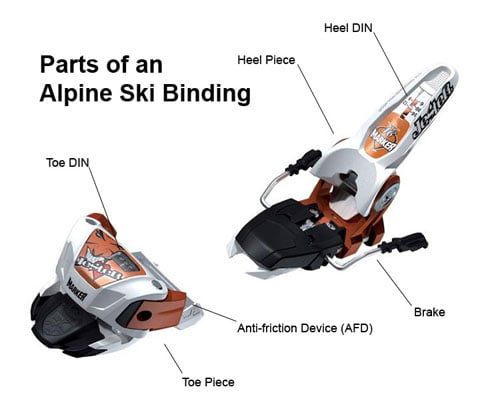
After selecting your ski bindings always have a certified ski technician mount and make the appropriate adjustments to ensure the bindings operate safely.
Ski Binding Brake Width
The arms attached to the heel piece of your ski bindings that stick out on the side of your ski are called brakes. Ski brakes are designed to stop your skis after release so you can retrieve them quickly and so they don't pose a danger to other skiers. Your skis’ waist width will determine the ski brake width (the distance between the two brake arms).For example, if your skis are 80mm wide at the waist, you will need bindings with a brake width of at least 80 mm and preferably no wider than 95 mm. If your brakes are too narrow they will not clear the edges of your skis and will not deploy properly when your ski comes off. If your brakes are too wide they may drag when you put your skis on edge, especially on steeper terrain. We recommend that you choose a brake width that is no more than 15mm wider than the waist width of your ski.
Wider brakes for fat powder skis can often be purchased separately. The narrow brake is removed from the ski bindings and replaced with the new wide brake. Not all binding models offer user swappable brakes, so ask your shop and have a certified technician perform the work if needed.
What is Ski Binding DIN?
DIN, short for Deutsches Institut für Normung (German Institute for Standardization), is the industry-adopted scale of release force settings for ski bindings. Though an identical set of standards is published by the International Standards Organization (ISO), most skiers continue to refer to binding settings as "DIN." The DIN setting will be set by a shop technician, based on your weight, height and ability level, when your bindings are mounted on your skis. The lower the DIN, the lower the force required to release from your bindings. Your skiing ability, as well as your weight, will help you determine the appropriate DIN range for your bindings. See our DIN chart below.
Ski Binding DIN Chart
Click your ability level to shop
| Skier Weight | 25-65 lbs | 30-100 lbs | 50-165 lbs | 65-200 lbs | 65-240 lbs | 65-250 lbs | 130-285lbs | 130-200lbs+ | 150-200lbs+ |
| Ability Level | Beginner - Intermediate | Beginner - Intermediate | Beginner - Intermediate | Beginner - Intermediate | Beginner - Advanced | Intermediate - Expert | Intermediate - Expert | Intermediate - Expert | Expert - Pro |
| Brief Description | Lightweight children | Junior skiers | Heavier beginning or beginning to advanced junior skiers | Intermediate junior skiers or lightweight beginning adult skiers. | Beginning skiers or lightweight intermediate to advanced adult skiers. | Intermediate skiers who are heavier or lighter weight expert adult skiers. | Heavier or more aggressive intermediate to expert adult skiers. | Heavier skiers, very aggressive advanced and expert adult skiers. | Aggressive expert big mountain skiers and racers. |
| DIN | .5 to 2.5 | .75 to 4.5 | 2 to 7 | 3 to 10 | 3 to 11 | 3 to 12 | 6 to 14 | 6 to 16 | 8 to 18 |
Important Notice: This chart is intended only to give you an idea of the general DIN range you need. There are a number of factors which influence binding adjustment and the settings must be precise, so use this information to help select an appropriate model of binding but don't try to set the DIN yourself. If you don’t find the answers to your binding questions in this guide please give our customer care team a call at 866-386-1590, Customer Care Hours.
Construction & Durability
Another important aspect of a ski binding is its strength. Higher DIN bindings designed for advanced and expert skiers are built with beefier construction and stronger materials to accomodate the higher forces generated while travelling at higher speeds and negotiating steeper, more technical terrain. Generally, the more advanced the skier the stronger and more elastic their binding should be. Attributes which contribute to a binding’s durability include material density and tensile strength, DIN range, metal parts instead of plastic, stiffness and design of pivot points.Ski Boot & Binding Compatibility
What If I Get New Ski Boots or My Boots Don’t Fit My Bindings?
If you buy new boots and want to use them with your old skis, you'll need to have your bindings adjusted to accommodate the new boot sole length and tested by a shop tech. Buying the same Mondopoint size does not guarantee that the boot sole length (BSL) will remain the same. All alpine bindings have some adjustability, but the range of adjustment is limited and in some cases, the bindings will have to be remounted to work with a new boot. Adjusting or remounting your ski bindings in these circumstances is not something you should do yourself. In all cases, it is highly recommended that any changes or adjustments to your bindings required to accommodate your boot be made by a certified technician.Alpine vs Touring Ski Boots
Traditional alpine (downhill) ski boots have a specific sole shape, defined by the international standard ISO 5355. Traditionally, adult and children's alpine boots conformed to this standard, and were mutually compatible with alpine bindings conforming to the related standard ISO 9462. Alpine boots normally have a "fixed" cuff, which is riveted in place for maximum support, while touring boots will all have some sort of mechanism to allow cuff mobility for striding.Alpine Touring boots use a different sole shape, referred to as ISO 9523, which is not compatible with many alpine bindings. In addition, there are two sole types which feature rockered traction soles with a smooth AFD pad at the toe. GripWalk soles are defined by ISO 23223, and are becoming common on both "crossover" boots with both alpine and touring capability, as well as an option on standard alpine boots. WTR is a non ISO-defined sole type that is gradually being phased out, but has a specific set of compatible bindings. Ask a certified technician if you're in doubt about a specific boot/binding combination.

Can I Use A Junior Boot In An Adult Binding?
All current alpine boot manufacturers make ski boots with different adult and junior norms that meet ISO (the International Organization for Standardization) specifications. Alpine ski boots are typically stamped with “ISO” or “DIN” to indicate that they conform to these norms.Generally, adult ski boot sole dimension norms begin at size mondopoint 22 (US Men’s Size 4) and go up to 31.5 or even higher. Junior ski boots run from mondopoint 14.5 to mondopoint 21.5. This is critically important to note, as you'll need a ski binding that conforms to either the adult norm or junior norm. You cannot use a junior norm ski boot with an adult ski binding. Most junior bindings, which have lower release settings, can accept adult boots but almost no adult bindings will accept junior boots. Before making a purchase or mounting decision, always confirm that the binding you select for a junior is, in fact, a junior-specific binding.
Junior Skis vs. Adult Skis
Ski bindings must be compatible with the user’s skis as well as their ski boots. A thin profiled junior ski is not deep enough to accommodate adult length ski binding screws. Adult screws are designed to sink approximately 8mm into the ski where junior binding screws are designed to sink only about 6mm. The extra length of an adult screw doesn’t seem like much but it is enough to leave bumps in the ski base of a junior ski. Additionally, if you were to use kids' binding screws on an adult ski the screws may not have enough depth to hold the binding to the ski under normal pressure applied by an adult.Specialized Ski Bindings
Demo Ski Bindings
Demo ski bindings are usually used on demo skis or rentals and are designed to adjust to a large range of boot sole lengths quickly and efficiently. If you buy a used ski package from evo or elsewhere, the ski bindings included may be demo bindings. Demo bindings often have a wheel or a scale on the plate between the heel and toe piece that will indicate the boot sole length the binding is set for. Although demo bindings are relatively easy to adjust, it is highly recommended that you have demo ski bindings properly adjusted and tested by a certified technician.Telemark Ski Bindings
Telemark bindings are designed to be used with telemark boots, which flex under the ball of the foot. The heel of the boot is free to travel up and down permanently in order to facilitate telemark turn technique. We do not currently sell telemark bindings.Alpine Touring Ski Bindings
Alpine Touring (AT) ski bindings allow the skier to lift their heel to travel uphill with climbing skins and lock it down for descending. AT bindings are designed for touring but can often be used successfully for lift-served skiing as well. Various design solutions offered by a number of manufacturers allow this (uphill and down) function.Alpine touring bindings can generally be divided into two types, frame bindings, and tech (Dynafit-type) bindings. Frame bindings have toe and heel pieces like alpine bindings that are connected by a plastic or metal frame, while tech bindings rely on the rigid sole of the ski boot as the "frame" and require a boot with special molded-in toe and heel fittings.
If you think you may be interested in alpine touring bindings, check out our guide on how to choose them here:


Mounting Your Ski Bindings
Once you decide on a pair of ski bindings, take them with your skis and both boots to your local ski shop to be mounted by a certified technician. You'll need to complete a mount form with your height, weight, age, boot sole length, and skier type. You are responsible for determining your skier type, normally described as I (beginner), II (intermediate) or III (advanced). A certified shop tech will have the proper equipment and knowledge to install your bindings and adjust them according to your ability level and preferences. The installation must be done professionally to ensure your bindings function as designed. Manufacturer's warranties will be void if the bindings are not mounted by a certified technician.Ski Binding Mounting Position
Mounting position affects how your skis perform in different snow conditions and terrain. Although most skis have a recommended (default) mounting position that works well for most people most of the time, that position may not suit your needs or preferences.Mounting the bindings farther back generally results in a less responsive, more stable feeling ski with more float in the powder. Mounting the bindings further forward generally gives you quicker turn response and improved performance when skiing switch (backward). If you are in doubt as to where to mount your skis, it's usually safest to use the manufacturer's recommended mount point.
If you wish to have your skis mounted at any position other than the manufacturer's recommended line, we strongly suggest that you measure out the mount point and draw a line on the ski yourself. This is the best way to ensure that your skis get mounted where you want them. For example, if you ask to have them “center-mounted,” “center” can have different meanings, so it’s best to draw the line and avoid any confusion.
Ski Boot Sole Wear
Excessive wear in the toe or heel of your ski boot can affect the boot/binding interface and compromise functionality. Check for excessive wear at least annually if not more frequently. A certified technician can inspect your boots for excessive wear using a template, and determine whether your boot soles are within the required limits.Ski Binding Toe Height Adjustment
Toe height is the height of the gap between the top of the toe piece and the AFD. Bindings typically require a clearance of about 0-0.5mm between the boot sole and the AFD to function properly. Many alpine bindings feature automatic toe height adjustment, while others should be manually adjusted by a certified technician.Shims and Canting
Skiers whose body geometry or personal preferences require canting or ramp angle adjustment can often be helped by installing shims under the bindings during the mounting process. If your natural stance places too much pressure on either your inside or outside edges, or if you feel your toe or heel is too high, ask your shop about this option.Maintaining Your Ski Bindings
Unless otherwise specified by the manufacturer, ski bindings are designed to be relatively free of maintenance. However, we strongly recommend that you have your bindings inspected by a certified technician before the start of each season.Keep bindings free of dirt, rust, salt and other contaminants. Don't attempt to wash or clean your bindings with soap or solvents as you may remove factory lubricants which are vital to proper operation and function. Always store your skis and bindings in a warm, dry place and do not leave bindings wet for long periods.
Ski Binding Glossary
Anti Friction Device (AFD)
The AFD can be a sliding mechanism or a low friction fixed device on the binding's toe piece that sits under your ski boot. It is a smooth piece designed to minimize friction between the binding and the boot during a lateral release. The purpose of the AFD is to allow the boot to slide sideways more smoothly during release.Elastic Movement
To reduce the likelihood of inadvertent release, bindings allow a certain amount of elastic travel for vertical and lateral movements before the skier releases. The elastic movement in your bindings is also designed to provide substantial shock absorption during landings or in bumps. Some bindings provide a greater range of elastic movement than others.Riser Plates
Riser plates reached a height of popularity in the mid 2000's with racers and carving oriented skiers, because they allowed more leverage and steeper lean angles. Because of limits placed on risers by the FIS (Fédération Internationale de Ski) and the growing popularity of types of skiing other than racing that lend themselves to a flatter binding placement, their popularity has dwindled.Flat Skis vs. Skis with Integrated Bindings
Skis sold without a binding are referred to in the industry as "flat." Most flat skis will accept most bindings, but there are exceptions. System or integrated bindings are mounted to a plate or track on the ski. These bindings are designed to be paired to a specific ski. If you are unsure about a specific ski/binding combination, ask a certified ski tech.



Learn More With Our Other Ski Guides:
Skis - Size Chart & Buyer's Guide
Skis - Kids' Size Chart and Buyer's Guide
Skis - Rocker Technology Explained
Ski Bindings – How to Choose & DIN Setting Chart
Ski Boots - Sizing & Buyer's Guide
Ski Boots - Boot Sole & Ski Binding Compatibility
Ski Boots – How to Make Your Boots Fit Better
Ski Poles - Size Chart
Skiing - Beginner Skiing Tips
Skiing - How to Fly With Skis
Skiing - How to Get in Shape
Ski Maintenance - Base Repair
Ski Maintenance – How to Store for the Summer
Ski Maintenance – How to Tune
Ski Maintenance – How to Wax
Outerwear - What to Wear Skiing
Outerwear - How to Wash & Waterproof
Outerwear - Regional Ski Guide
Gloves & Mittens - How to Choose
Goggles - How to Choose
Goggles - Wearing Goggles with Glasses
Helmets - How to Choose & Fit Guide
Footbeds - How to Choose
Ski Socks - Sizing & Buyer's Guide
Travel - How to Fly with Skis
Alpine Touring Skis - How to Choose
Avalanche Probes - How to Choose
Backcountry - Choosing an Avalanche Airbag Pack
Backcountry - Choosing an Avalanche Beacon
Backcountry - Climbing Skins Size Guide
Backcountry - Dynafit / Tech Binding Basics
Backcountry - How to Buy Alpine Touring Bindings
Backcountry - How to Buy Alpine Touring Ski Boots
Backcountry - How to Choose an Avalanche Shovel
Backcountry - How to Choose Climbing Skins
Backcountry Backpacks - How to Choose
Backcountry Basics - How to Get Started
This is evo. We are a ski, snowboard, wake, skate, bike, surf, camp, and clothing online retailer with physical stores in Seattle, Portland, Denver, Salt Lake City, Whistler, and Snoqualmie Pass. Our goal is to provide you with great information to make both your purchase and upkeep easy.
evo also likes to travel to remote places across the globe in search of world-class powder turns, epic waves, or legendary mountain biking locations through evoTrip Adventure Travel Trips. Or, if you prefer to travel on your own, check out our ski & snowboard resort travel guides and mountain bike trail guides.
Still have questions? Please call our customer care team at 1.866.386.1590 during Customer Care Hours. They can help you find the right setup to fit your needs.


